The Internet's Premier Classical Music Source
Related Links
- Recommended Recordings
Recommended Biographies
Recommended Scores
CD / DVD Reviews - Chopin Works List
- Interpreting Chopin
by Angela Lear - Audio Samples:
 (MIDI)
 - Nocturne #2
- Preludes #1, 2, 3, 4 & 20
- Scherzo #1
- Waltz in D Flat
-
Find CDs & Downloads
Amazon - UK - Germany - Canada - France - Japan
ArkivMusic - CD Universe
Find DVDs & Blu-ray
Amazon - UK - Germany - Canada - France - Japan
ArkivMusic-Video Universe
Find Scores & Sheet Music
Sheet Music Plus -
- Comments on Selected Works by Perry Cheng
- Chopin Foundation of the United States
- Chopin: The Poet of the Piano by Tran Luong Anh
Recommended Links

Site News
Site Search
Follow us on


Affiliates










Frédéric Chopin

(1810 - 1849)
Frédéric François Chopin (March 1, 1810 - October 17, 1849), is remembered today as the composer of some of the most challenging and subjective music in the whole of the keyboard repertoire. A Pole who spent his mature years in France, he brought to his music a keen interest in his native musical forms and was a precursor of the "nationalist" composers who did so much to bring new life to Classical music during the course of the 19th century.
Chopin was another of the blighted Romantic generation who was doomed to die young through physical infirmity; in his case it was not syphilis which claimed Franz Schubert and Robert Schumann. but tuberculosis which also killed Carl Maria von Weber. Frédéric was the only boy of four children born to Nicholas Chopin, a professor of French at the Warsaw Lyceum, and his wife Justine. His father taught him until he was old enough to go to the Lyceum, but his musical proclivities manifested themselves early and at the age of seven he began piano lessons with the Polish virtuoso Wojciech Żywny. The lessons were so successful that the young boy played at a public concert before he was nine. He also wrote a little march for the Russian Grand Duke Constantine, who not only accepted the dedication but had the work scored for military band.
At the age of sixteen Chopin entered the Warsaw Conservatory where he was taught by the composer Józef Antoni Franciszek Elsner (1769-1854). Elsner was helpful in a number of ways, but two in particular: he taught Chopin the value of sheer hard work, and ignited in him a passionate interest in the music and culture of Poland; the latter was to become especially significant to Chopin later in life. By 1828 his student days were over and he departed for Berlin, where he heard a series of new operas and also caught glimpses of musical personalities such as the Italian opera composer Gaspare Spontini (then very fashionable) and Felix Mendelssohn (only twenty at the time but already making his way). Duly inspired, he traveled to Vienna where a Count Gallenberg, apprised of his abilities, had organized two concerts. These went well, and this early success was enough to convince Chopin that he could earn his living as a traveling virtuoso.
Returning to Warsaw, Chopin lost his heart to a Conservatory student, Constantia Gladkowska. It is believed that his feelings for her inspired the beautiful slow movement of the F minor Piano Concerto (called #2, although composed prior to #1). Whatever the emotional reasons for this work, it is true to say that both concertos were written to satisfy the young virtuoso's need for concert works to play while establishing himself as an international performer. In late 1830 he embarked on an extensive tour which took him to various German towns, then on to Prague, Vienna, Munich and finally to Paris, where he arrived in 1831. The tour had not been financially rewarding, but it had at least kept him away from the ferment of the Polish Uprising of 1831 which at one point he was tempted to join, but the brutal Russian response persuaded him to keep clear of his homeland for a while.
In his music he poured out his reaction to what was happening to Poland, especially in the Etude in C minor, Op. 10 #12. Paris was receptive to a gifted Pole at such a time, and Chopin quickly met the cream of Parisian musical life, including Luigi Cherubini, Giacomo Meyerbeer and Franz Liszt. At his first concert, at which he played his Concerto for Piano in F minor, Mendelssohn led the way by applauding with great enthusiasm. But Chopin's style of playing was not generally delivered with sufficient bravura to set the Parisian audiences alight. It was not until the intervention of the Rothschild family, offering him tutoring work and engagements for private functions, that he earned sufficient income to spend the majority of his time composing. In the year that followed he gradually began to acquire a reputation in both France and Germany, and his works – waltzes, mazurkas, etudes and preludes, as well as other keyboard pieces – began to receive regular publication.
Chopin remained single, although an affair with Marie, daughter of Count Wodzinski, was terminated by her parents only after a prolonged attempt by the couple to win them over. One of the Wodzinski's reasons for discouraging the match was Chopin's already poor state of health. In July 1837 he visited England to obtain professional advice on his condition; the prognosis was not good, and Chopin returned to Paris with a good idea of what ailed him: he had consumption.
Prior to his London visit, Chopin had been introduced by Liszt to the fashionable and free-thinking novelist George Sand, a woman of generally gargantuan appetites. On Chopin's return to Paris the two began an affair which would last for a decade and was characterized by violent emotional storms and constant jealousy on Chopin's part. A woman of resource and experience, Sand had already been married and separated, and for her Chopin was the latest affair. In late 1839 she persuaded him to escape Paris with her and winter in Majorca. While this adventure began happily enough, things began to unravel as winter arrived in earnest and Chopin fell seriously ill. Due to Chopin's illness, they were asked to leave their comfortable apartments, finding refuge in a damp, cold monastery. Sand, with a family of her own to support, tended to the sick composer and managed to get him back to Marseilles, where she arranged for the best doctors available to aid his recovery. From Marseilles they moved to Sand's country house at Nohant, where Chopin put the finishing touches to his 24 Preludes and the famous Sonata for Piano #2 in B Flat minor into which he interpolated an earlier funeral march; such was his state of mind at the time.
For the next few years Chopin's life revolved around George Sand and the company she kept: whether they were in Paris or spending their summers at Nohant, Chopin either composed or spent as much time with Sand as she was prepared to give him. This should have sounded warning bells to the increasingly dependent Chopin, but if they tolled, he did not hear them. Sand was bound to tire of such dependency, and by the mid-1840s the danger signs were multiplying. Sand wanted her freedom once more, and although she still admired him, he no longer stimulated her. He never felt completely at ease with her children, and grew increasingly unwilling to share her with them. One of the characters in her novel Lucrezia Floriani was a Polish prince by the name of Karol; a thinly-disguised portrait of Chopin, it was almost entirely unflattering, and gave the distinct impression that Sand was looking for an excuse to break with Chopin long before the series of quarrels in 1847 which finally drove them apart. The novel was published soon after their separation, causing the ailing man considerable distress.
Such turmoil did not improve his state of health; when his Sonata for Cello and Piano Op. 65 was published, it was not hard to believe that it would be the last work published in his lifetime. The following February he gave what proved to be his final Paris concert. With the outbreak of the revolution in 1848, he hastily left for London. Although a tour of Britain was organized for him with every good intention, it clearly overtaxed his waning strength, and when he reached Scotland in October, he collapsed and took to his bed. He was tended closely by friends and admirers, and his journey back to Paris was arranged with every consideration. He arrived in the French capital in November, low in spirits and unable to rally his strength. Although he continued to plan new works, he no longer had the strength to compose the music which had given his life its shape and meaning. He survived into the summer of 1849, but the arrival of autumn and the cold weather brought about the final collapse, and he died that October. At his funeral in the Chapelle de la Madeleine, Mozart's Requiem was performed, as he had requested.
Chopin's legacy consists almost entirely of works for the piano. The instrument was everything to him, and he found previously undreamt of levels of subtlety and expression within its keys. He was acknowledged as a virtuoso, but one who had a very distinctive style, concentrating on delicacy of touch and extreme variations of dynamics and color. He was singularly gifted in the realm of melody, and was also a key figure in the popularizing of the polonaise, mazurka and other dance rhythms which was to lead many later composers to study closely the music of their own countries. Chopin's music is often mercurial, and can move from the dreaminess of the nocturnes to the fire and spirit of the ballades and polonaises, the elegance and dash of his waltzes to the brutal emotional realism of his sonatas. His output was relatively slim, and of his orchestral works only the two piano concertos have held their place in the popular repertoire, but the diversity and variety of his keyboard achievements, and the phenomenal technical challenges set by his solo pieces, have given him a special place in the development of music.

Recommended Recordings
Andante Spianato & Grande Polonaise, Op. 22

- Andante spianato & Grande Polonaise brillante; Polonaise #6, Variations brillantes, Mazurkas, Piano Sonata #3, etc./Telarc CD-80280
-
Malcolm Frager (piano)
- Andante spianato & Grande Polonaise brillante; Piano Concerto #1, Preludes, Scherzo #2, Sonata #2/Deutsche Grammophon Panorama 469127-2
-
Martha Argerich (piano)
- Andante spianato & Grande Polonaise brillante; Piano Concerto #2, Concerto Rondo/Philips 420654-2
-
Claudio Arrau (piano)
 Ballades, Opp. 23, 38, 47 & 52

- 4 Ballades; 4 Scherzos/Chesky CD44
-
Earl Wild (piano)
- 4 Ballades; Barcarolle Op. 60 & Fantasie Op. 49/Deutsche Grammophon 423090-2
-
Krystian Zimerman (piano)
- 4 Ballades, 4 Scherzos/RCA Living Stereo Hybrid Multichannel SACD 82876-61396-2
-
Artur Rubinstein (piano)
- 4 Ballades; Mazurkas, Etudes, Waltzes, etc./Sony SK64399
-
Murray Perahia (piano)
- 4 Ballades; 4 Scherzos/Hyperion CDA67456
-
Stephen Hough (piano)
- 4 Ballades; Barcarolle, Berceuse, Scherzo/RCA Red Seal 09026-63259-2
-
Evgeny Kissin (piano)

Concertos for Piano #1, Op. 11 and #2 Op. 21

- Piano Concertos #1 & 2, Variations on Mozart's "Là ci darem", Andante spianato et Grand polonaise brillante, Krakowiak, Fantasy on Polish Airs/Vox Music Group CDX5002
-
Abbey Simon (piano), Heribert Beissel/Hamburg Symphony Orchestra
- Piano Concertos #1 & 2/Sony SK44922
-
Murray Perahia (piano), Zubin Mehta/Isreal Philharmonic Orchestra
- Piano Concerto #1, Nocturnes, Ballade #1, Polonaise #6/EMI CDM7643542 reissued as 72435-67549-2
-
Maurizio Pollini (piano), Paul Kletzki/Philharmonia Orchestra of London
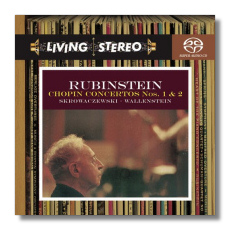
- Piano Concertos #1 & 2/RCA Living Stereo Hybrid Multichannel SACD 82876-67902-2
-
Artur Rubinstein (piano), Stanislaw Skrowaczewski/New Symphony Orchestra of London & Alfred Wallenstein/Symphony of the Air
- Piano Concertos #1 & 2/Deutsche Grammophon 415970-2 reissued as 463662-2
-
Krystian Zimerman (piano), Carlo Maria Giulini/Los Angeles Philharmonic Orchestra
- Piano Concerto #1 w/ Liszt/Deutsche Grammophon 415061-2 reissued as 449719-2
-
Martha Argerich (piano), Claudio Abbado/London Symphony Orchestra
Etudes, Opp. 10 & 25

- 24 Études/Deutsche Grammophon 413794-2
-
Maurizio Pollini (piano)
- 24 Études and 3 Unpublished Études/Music & Arts CD-1229
-
Juana Zayas (piano)
- 24 Études/Sony SK61885
-
Murray Perahia (piano)
Amazon - UK - Germany - Canada - France - Japan - ArkivMusic - CD Universe
Or reissed in an expanded edition as Sony Masterworks SK92731
Amazon - UK - Germany - Canada - France - Japan - ArkivMusic - CD Universe
Or available as a stereo SACD on Sony SS61885
Amazon - UK - Germany - Canada - France - Japan - ArkivMusic
- 24 Etudes; 19 Waltzes, Ballades/EMI Double Forte 574290-2
-
Agustín Anievas (piano)
- 24 Études and 3 Unpublished Études/Chandos CHAN8482
-
Louis Lortie (piano)
Impromptus, Opp. 29, 36, 51 & 66

- 4 Impromptus; Berceuse Op. 57, Barcarolle Op. 60 and Fantasie Op. 49/CBS MK39708
-
Murray Perahia (piano)
- 4 Impromptus; Waltzes/RCA Red Seal 09026-63047-2
-
Artur Rubinstein
Amazon - UK - Germany - Canada - France - Japan - ArkivMusic - CD Universe
Or reissued on RCA Red Seal 59422-2
Amazon - UK - Germany - Canada - France - Japan - ArkivMusic - CD Universe - 4 Impromptus; Preludes/Philips 4757768
-
Claudio Arrau (piano)
- 4 Impromptus; Scherzi/Deutsche Grammophon 474516-2
-
Yundi Li (piano)
Amazon - UK - Germany - Canada - France - Japan - ArkivMusic - CD Universe
Or available on Hybrid Multichannel SACD 474878-2
Amazon - UK - Germany - Canada - France - Japan - ArkivMusic - CD Universe
Krakowiak for Piano & Orchestra, Op. 14

- Rondo à la Krakowiak, Piano Concertos, Variations on Mozart's "Là ci darem", Andante spianato et Grand polonaise brillante, Fantasy on Polish Airs, Impromptus/Philips 420654-2 or reissued as 438338-2
-
Claudio Arrau (piano), Eliahu Inbal/London Philharmonic Orchestra
- Rondo à la Krakowiak, Piano Concertos, Variations on Mozart's "Là ci darem", Andante spianato et Grand polonaise brillante, Fantasy on Polish Airs/Vox Music Group CDX5002
-
Abbey Simon (piano), Heribert Beissel/Hamburg Symphony Orchestra
Mazurkas

- 58 Mazurkas/Harmonia Mundi HMU907247/48
-
Frederic Chiu (piano)
- 51 Mazurkas/Warner Finnadar 791071-2
-
Andrzej Wasowski (piano)
- 51 Mazurkas; Sonatas 2 & 3/EMI Classics 07243-575443-2
-
Samson François (piano)
- 51 Mazurkas/RCA Red Seal 09026-63050-2
-
Artur Rubinstein (piano)
- 58 Mazurkas/London Double Decca 448086-2
-
Vladimir Ashkenazy (piano)
- 10 Mazurkas; Prelude Op. 45, Ballade Op. 23/Deutsche Grammophon 413449-2
-
Arturo Benedetti Michelangeli (piano)
Amazon - UK - Germany - Canada - France - Japan - ArkivMusic - CD Universe
Or reissued as Deutsche Grammophon Originals 4777563
Amazon - UK - Germany - Canada - France - Japan - ArkivMusic - CD Universe - 57 Mazurkas/Hyperion Helios CDH55391 & CDH55392
-
Garrick Ohlsson (piano)
Volume 1 - Hyperion CDH55391
Amazon - UK - Germany - Canada - France - Japan - ArkivMusic - CD Universe
Volume 2 - Hyperion CDH55392
Amazon - UK - Germany - Canada - France - Japan - ArkivMusic - CD Universe

Misc. Piano Music (Sonatas, Barcarolle, Berceuse, Fantaisie, Rondo, Tarantelle)

- Barcarolle Op. 60 and Fantasie Op. 49; Ballades/Deutsche Grammophon 423090-2
-
Krystian Zimerman (piano)
- Berceuse Op. 57, Barcarolle Op. 60 and Fantasie Op. 49; Impromptus/CBS MK39708
-
Murray Perahia (piano)
- Fantasie Op. 49; Waltzes, Nocturnes , Polonaise, Scherzo/RCA Red Seal 09026-60445-2
-
Evgeny Kissin (piano)
-
Barcarolle Op. 60; Polonaise, Waltzes, Etudes, Nocturnes, Mazurkas, etc./London Double Decca 444830-2

-
Vladimir Ashkenazy (piano)
- Berceuse Op. 57, Barcarolle Op. 60 and Fantasie Op. 49; Sonatas #2 & 3/RCA Victor Red Seal 63046-2
-
Artur Rubinstein (piano)
- Berceuse Op. 57, Barcarolle Op. 60; Preludes, Impromptus/EMI Great Recordings of the Century Mono 61542-2
-
Alfred Cortot (piano)
Nocturnes, Opp. 9, 15, 27, 32, 37, 48, 55, 62, 72

- 21 Nocturnes/Hyperion CDA66341/2
-
Lívia Rév (piano)
Amazon - UK - Germany - Canada - France - Japan
Or reissued on Hyperion Dyad CDD22013
Amazon - UK - Germany - Canada - France - Japan - ArkivMusic - CD Universe
- 19 Nocturnes/Nonesuch 979233-2
-
Ivan Moravec (piano)
Amazon - UK - Germany - Canada - France - Japan - ArkivMusic - CD Universe
Or reissued on Nonesuch Ultima 979564-2
Amazon - UK - Germany - Canada - France - Japan
- 21 Nocturnes; Barcarolle Op. 60, Fantaisie Op. 49/Philips 464694-2
-
Claudio Arrau (piano)

- 21 Nocturnes/Deutsche Grammophon 447096-2
-
Maria-João Pires (piano)
Amazon - UK - Germany - Canada - France - Japan
Or as a single-disc selection of 12 Nocturnes on DGG 4777583
Amazon - UK - Germany - Canada - France - Japan - ArkivMusic - CD Universe
- 21 Nocturnes; Impromptus/Hyperion CDA67371/2
-
Angela Hewitt (piano)
Polonaises

- 7 Polonaises Op. 26, 40, 44, 53 & 61/Deutsche Grammophon 415117-2
-
Maurizio Pollini (piano)
- 7 Polonaises Op. 26, 40, 44, 53 & 61/Brilliant Classics 93995
-
Folke Nauta (piano)
- 16 Polonaises; Barcarolle, Berceuse, Etudes/London Double Decca 452167-2
-
Vladimir Ashkenazy (piano)
Preludes, Op. 28

- 26 Preludes; Barcarolle, Polonaise, Scherzo/Deutsche Grammophon Galleria 415836-2
-
Martha Argerich (piano)
- 24 Preludes; Impromptus/Philips 4757768
-
Claudio Arrau (piano)
Amazon - UK - Germany - Canada - France - Japan - ArkivMusic - CD Universe
Or all 26 Preludes with Schumann on Pentatone Hybrid Multichannel SACD PTC5186165
Amazon - UK - Germany - Canada - France - Japan - ArkivMusic - CD Universe
-
24 Preludes; Scherzos, Waltzes/London Double Decca 460991-2

-
Vladimir Ashkenazy (piano)
- 24 Preludes/Deutsche Grammophon 413796-2
-
Maurizio Pollini (piano)
- 24 Preludes/Naive Opus 111 30336
-
Grigory Sokolov (piano)
Scherzos, Opp. 20, 31, 39 & 54

- 4 Scherzos, 4 Ballades/Chesky CD44
-
Earl Wild (piano)
Amazon - UK - Germany - Canada - France - Japan
Reissued as Ivory Classics 64405-75001
Amazon - UK - Germany - Canada - France - Japan - ArkivMusic - CD Universe
- 4 Scherzos, 4 Ballades/RCA Living Stereo Hybrid Multichannel SACD 82876-61396-2
-
Artur Rubinstein (piano)
Amazon - UK - Germany - Canada - France - Japan - ArkivMusic - CD Universe
Or the 1990 RCA CD issue RCD1-7156
Amazon - UK - Germany - Canada - France - Japan
- Scherzos, Variations on "Là ci darem la mano"/Hyperion CDA66514
-
Nikolai Demidenko (piano)
 Amazon - UK - Germany - Canada - France - Japan
Reissued as Hyperion Helios CDH55181
Amazon - UK - Germany - Canada - France - Japan - ArkivMusic - CD Universe
- Scherzos/Deutsche Grammophon 439947-2
-
Ivo Pogorelich (piano)
- Scherzos, Sonata #2/EMI 75586-2
-
Simon Trpceski (piano)
Sonata for Cello & Piano in G minor, Op. 65

- Cello Sonata w/ Franck/EMI CDM763184-2
-
Jacqueline du Pré (cello), Daniel Barenboim (piano)
- Cello Sonata, Introduction and Polonaise, Ballades #3 & 4/Deutsche Grammophon 4776579
-
Mstislav Rostropovich (cello), Martha Argerich (piano)
- Cello Sonata w/ Alkan/Hyperion CDA67624
-
Alban Gerhardt (cello), Steven Osborne (piano)
- Cello Sonata w/ Grieg Sonata/Claves CD50-703
-
Claude Starck (cello), Ricardo Requelo (piano)
- Cello Sonata, Grand Duo, Piano Trio, Introduction & Polonaise w/ Moniuszko/Le Chant Du Monde LDC278.831/832
- Stanislas Firlej (cello), Anna Wesolowska (piano)
Sonatas for Piano (2, 3), Opp. 4, 35 & 58

- Sonatas #2 & 3; Fantaisie/RCA Red Seal 5616-2-RC
-
Artur Rubinstein (piano)
- Sonatas #2 & 3/Deutsche Grammophon 415346-2
-
Maurizio Pollini (piano)
- Sonatas #2 & 3; Scherzo/Deutsche Grammophon Galleria 419055-2
-
Martha Argerich (piano)
- Sonatas #2 & 3/Virgin 565466-2
-
Leif Ove Andsnes (piano)
Les Sylphides (Ballet arranged by Douglas from Chopin's Piano Music)

- Ballet Suite "Les Sylphides" w/ Delibes & Gounod/Philips Duo 438763-2
-
David Zinman/Rotterdam Philharmonic Orchestra
- Ballet Suite "Les Sylphides" w/ Delibes/Capriccio 10073
-
Heinz Fricke/Berlin Radio Symphony Orchestra
- Ballet Suite "Les Sylphides"/London 430723-2
-
Richard Bonynge/National Philharmonic Orchestra
Variations on "Là ci darem la mano", Op. 2

- Variations on Mozart's "Là ci darem la mano", Rondo à la Krakowiak, Piano Concertos, Andante spianato et Grand polonaise brillante, Fantasy on Polish Airs/Vox Music Group CDX5002
-
Abbey Simon (piano), Heribert Beissel/Hamburg Symphony Orchestra
- Variations on Mozart's "Là ci darem la mano", Scherzos/Hyperion CDA66514
-
Nikolai Demidenko (piano)
Amazon - UK - Germany - Canada - France - Japan
Reissued as Hyperion Helios CDH55181
Amazon - UK - Germany - Canada - France - Japan - ArkivMusic - CD Universe
Waltzes, Opp. 18, 34, 42, 64, 69 & 70

- 14 Waltzes; Impromptus, Bolero/RCA Red Seal 09026-63047-2
-
Artur Rubinstein
Amazon - UK - Germany - Canada - France - Japan - ArkivMusic - CD Universe
Or reissued on RCA Red Seal 59422-2
Amazon - UK - Germany - Canada - France - Japan - ArkivMusic - CD Universe - 19 Waltzes/London Decca 414600-2
-
Vladimir Ashkenazy (piano)
Amazon - UK - Germany - Canada - France - Japan - ArkivMusic - CD Universe
Or with Preludes & Scherzos on London Double Decca 460991-2
Amazon - UK - Germany - Canada - France - Japan - ArkivMusic - CD Universe - 14 Waltzes; Barcarolle, Nocturne, Mazurka/EMI Great Performances of the Century 566904-2
-
Dinu Lipatti (piano)
- 19 Waltzes/Harmonia Mundi HMX2901927
-
Alexandre Tharaud (piano)
- 20 Waltzes/EMI 98351-2
-
Ingrid Fliter (piano)